
Porch and deck
Rotted deck or porch rail connections: what an assessment checks
Know which visible clues to report at a deck or porch rail, why connections matter, and what a repair assessment should clarify.
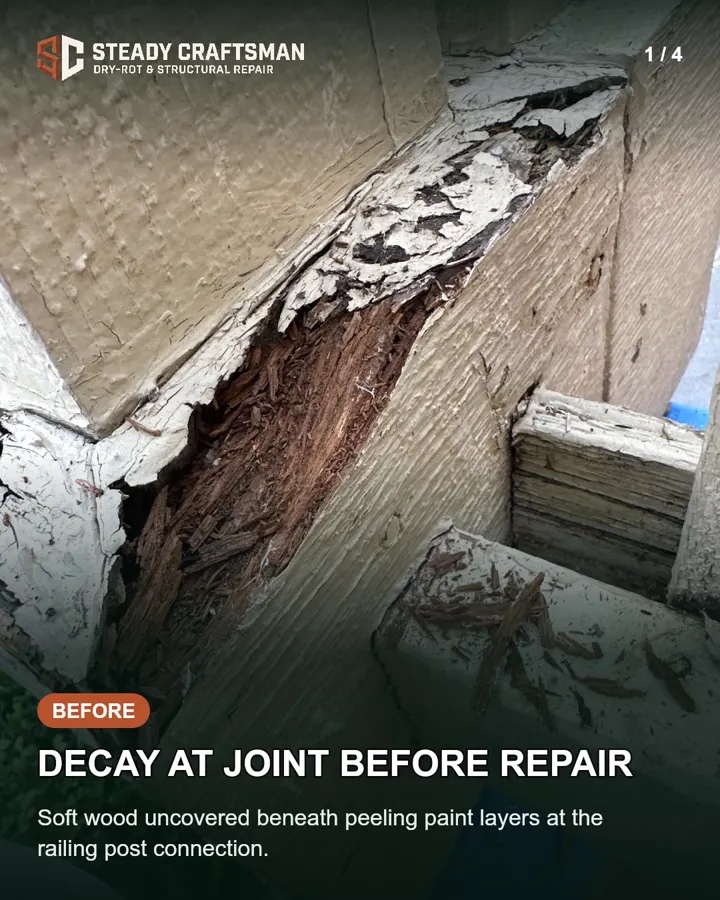
A railing can look presentable from several feet away while the wood at a post or connection is deteriorating. If a rail feels loose, a post moves, or a walking edge looks damaged, the priority is the person's safety, not the paint. Keep people away from the questionable rail, step or deck edge and arrange an assessment. Do not lean on it to “test” its strength, remove a fastener, or climb below a deck to inspect it yourself.
Look at the connection, not only the long rail
Connections are where a rail, post, deck or porch structure meets another piece. Water can linger at joints, open end grain and horizontal details. The USDA Forest Products Laboratory’s condition-assessment manual includes visual inspection as part of a broader wood and timber assessment. Visible staining, altered surfaces or damaged wood are clues to report, not confirmation that every concealed connection is sound. A sound-looking painted face therefore does not prove the connection behind it is sound.
From a safe spot, take an overview showing where the rail sits along the steps or deck. Note any missing piece, visibly split wood, loose hardware, open joint, rust stain, peeling finish or movement you have noticed during normal use. Do not force movement to create evidence. If the rail already moves, include that in your description and stop using it as a handhold. A close-up can be useful only if you can get it without approaching an unsafe edge.
Questions the scope needs to answer
An assessment should identify which visible connections are affected and whether the adjacent posts, rails, decking, steps or attachment points need further examination. It should explain where access is limited and whether opening or removing a finish is necessary to establish the repair boundary. The specific fasteners, wood members, finish and any separate waterproofing or structural questions belong in the property-specific scope. A photo cannot show all concealed connections or establish a load rating.
The moisture path matters as much as the visible soft board. If water continues to collect at the joint, a cosmetic patch or fresh coating may hide the same problem for a while without addressing it. A useful repair scope considers why the joint gets wet, not just which board looks damaged. The practical question is what allowed the joint to stay wet and which part of that work belongs in this repair versus another specialist's scope.
A project example, with its limits
Our porch-railing project gallery follows one company-shared sequence: deteriorated painted wood at a connection, a new wood post, protected surfaces before painting, and the completed cream-painted railing. The photos and walkthrough document those visible stages. They do not identify the job city or individual crew, certify concealed structure, or promise the same scope for another home. This is genuine project proof, not a customer testimonial.
Before asking for a quote, record the location, how the rail is used, the visible condition and whether people can avoid the area until it is reviewed. Mention steps, height and access constraints. A scope discussion can then separate immediate safety concerns, wood replacement, connection details, finish work and any question that needs a different qualified professional. Explore the Bay Area porch-railing service to see the existing process and request path.